

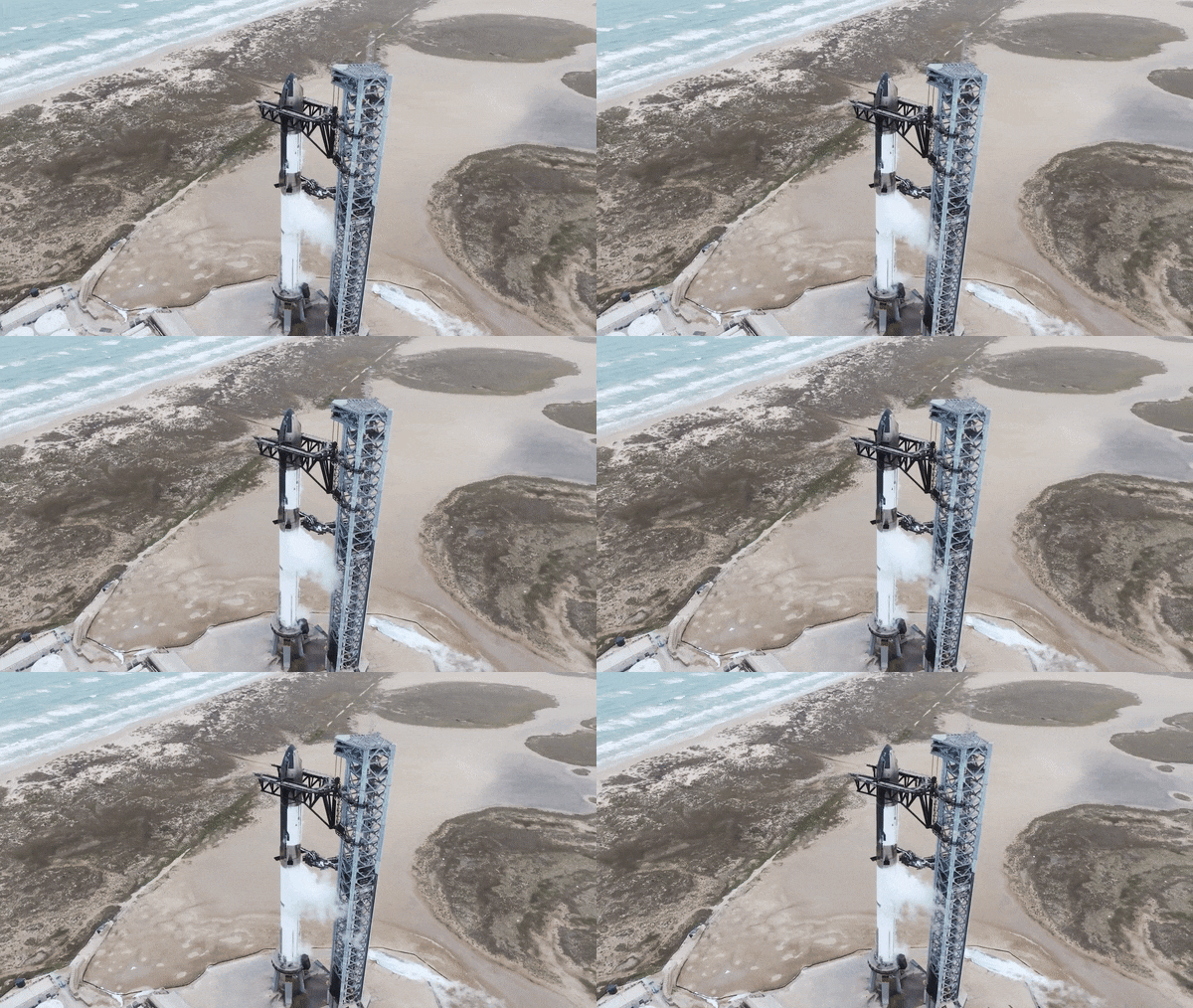

The company conducted the wet dress rehearsal at SpaceX's Starbase facility in Boca Chica, Texas. Standing 120 meters tall, and held firmly by the launch tower's mechanical arms, the fully stacked Starship swallowed more than 4,500 tons of liquid methane and oxygen propellants. During wet dress rehearsals, the rockets are fully loaded with propellants while the ground crews rehearse the countdown, but there is no firing of the engines or launch.
SpaceX refrained from making any formal announcements ahead of the test, but outside observers on the ground could tell what was happening: Thick plumes of methane poured out of the rocket as layers of frost formed on its surface. Only after the test was over did SpaceX announce what had happened.
“Starship has today completed its first wet, flight-like dress rehearsal on Starbase,” the company wrote in a tweet . “This marks the first time that an integrated Ship and Booster have been fully loaded with more than 10 million pounds of propellants,” SpaceX said, adding that Monday's test “will help verify a complete launch countdown sequence. , as well as the performance of Starship and the orbital platform for operations similar to those of a flight”.
That SpaceX managed to succeed with a wet dress rehearsal on its first attempt may seem surprising, especially given the challenges NASA faced attempting the same thing with its Space Launch System (SLS) rocket. The space agency " succeeded " after its fourth wet test attempt and was forced to conduct a fifth test on September 21, 2022 after failing to launch the rocket on two attempts. The situation with SpaceX is a bit different, as it had already done limited propellant static firing tests , but the key is that Starship uses methane and not hydrogen, the latter propellant being notoriously unwieldy due to its tendency to leach out of the ship. propellant through the smallest openings.
The next major milestone will likely be a static ignition test, during which all 33 Raptor engines will fire. Each Raptor engine is capable of exerting almost 2,265,000 newtons , achieving a combined takeoff thrust of 74,567,000 newtons. When the Starship finally takes off, it will become the most powerful operational rocket in the world, surpassing the SLS by a significant margin (the SLS Block 1 configuration is 39,019,948 newtons).
A successful static ignition test would conclude major test milestones and set the stage for Starship's maiden orbital launch. In a tweet earlier this month, SpaceX CEO Elon Musk said the company has "a real shot at the end of February," and that "a March launch attempt looks very likely." Musk's roadmaps are notoriously dodgy, but we can safely say that SpaceX seems to be making steady progress with its megarocket and that a maiden voyage is on the horizon.
Musk, perhaps more than anyone, is looking forward to seeing Starship take off in the very near future. SpaceX has big plans for the vehicle, positioning it as a rocket to carry people, cargo and satellites into orbit around Earth, the Moon, Mars and other places in the solar system. More pressingly, the company would very much like to use Starship to bring its second-generation Starlink satellites to low-Earth orbit, as the Falcon 9 rocket is unsuited for the task, requiring the company to produce smaller Gen2 variants. .
NASA also needed the two-stage megarocket to succeed, as SpaceX has a contract with the space agency to develop two separate Artemis lunar modules with the Starship . The first of these missions, Artemis 3, is scheduled for 2025, which isn't too far off.


0 Comentarios